

Hi, I am posting this blog book about the melancholy fate of the barque Charles Eaton. I became fascinated with the story about 31 years ago and have been researching it off and on ever since but mostly off these days. Admittedly there were long periods in the early days when the research sat gathering dust in a box, while the original photocopies, print-outs, handwritten notes and notebooks turned yellow with age. Initially it was difficult to find fresh material on the subject, but with the advent of the Internet/digital age the task got a whole lot easier, largely thanks to our wonderful libraries in Australia. I would particularly like to thank the National Library of Australia and the State Library of Victoria for their superb online catalogue material. The State Library of New South Wales contributed material for some of the earlier research and their resources continue to be invaluable. And of course there is the irreplacable Trove newspaper archives for Australia. I will also mention all the antique books and lithographs I bought along the way. The whole exercise was a lot of fun when I look back on it now before my memory fails me.
Here is an example of how history research can have it’s joyful moments. I was looking up a different story in an old Calcutta newspaper last week when suddenly the name Captain Thomas D’Oyly leapt off the page and there was the family’s street address for their bungalow near Dum Dum. One person’s trivia is another person’s treasure.
Another example. I managed to buy an genuine antiquarian book/pamphlet by William Wemyss for a bargain price. Also useful was a photocopy of the account of the D’Oyly family by William D’Oyly Bayley, which I bought from the American Library of Congress. D’Oyly Bayley’s book had a print run of 100 copies for his doctoral research and I am guessing that the Library of Congress copy is the only one in the public domain if you can afford the massive photocopies.
Another ‘Eureka!’ moment was when I bought a painting of the original Sion Hill manor at Kirby Wiske in North Riding, Yorkshire. Tracking down the original painting was great fun for me, if perhaps tedious for everyone else entitled to think: “Yeah but so what?”. Sometimes you have to indulge the researcher for their moments of triumph. Tracking down and buying 15 original circa 1802 watercolour sketches of life in colonial Calcutta was also a personal pleasure that will have to be indulged I’m afraid.
Getting this blog taken up by the National Library of Australia in 2014 for their Pandora Archive was also an ego boost for me. This blog will die when I do, so it’s nice to know that a blog copy will live on for a while, via Pandora. One can dream.
Most of the research material has been acquired from excellent primary and contemporary sources, eye-witness accounts and the like. Where it has been possible to do so, I have aimed for corroboration from other relevant and reliable sources. It was a hard slog in those early days when we had to rely on microfilm, visits to libraries all over Australia and overseas and extraordinary persistence — but by golly it was worth it. The journey alone gave me satisfaction of the kind that you can’t get to the exact degree in the research-friendly Internet age.
The blog runs to about 85,000 words, which is typical for a non-fiction book but super, super long for a blog, so you might want to dip in then out. That’s okay, I do it all the time. Most of the images are part of my own collection. The remainder were acquired from Wikimedia Commons and are in the public arena. Collecting antique lithographs and paintings is a hobby that I inadvertently acquired along the way. One of the side benefits of being a bit of a history enthusiast.
I have been amazed at the number of international readers that the blog attracted. More than 100 nations are represented on my reader’s list and that’s pretty cool. Clearly maritime history is a specialist genre with no boundaries, especially when Google does the translating for you.
It is never possible to draw a line in the sand where history research is concerned. If you have some additional information or corrections that you think I might like I would love to hear from you via a comment.
I have used WordPress.com for my blog but it may not suit everyone. My material and research get used word-for-word at times without acknowledgement and I have become used to that. However, there are some advantages to publishing online. The main one is that it doesn’t cost anything, and there have been, in recent years, some self-published books about the Charles Eaton but I could never afford to go down that path.
The second advantage is that you are free to update as new information comes to light and I especially like doing that if previous sourced information proves to be incorrect or unreliable.
HOME PART 1: PART 2: PART 3: PART 4: PART 5: PART 6: ABOUT ME

 Charles Eaton: wake for the melancholy shipwreck
Fantastic bit of scholarship and a fascinating read! Thanks Veronica
Hi Veronica
I’m interested in your blog because Charles Eaton was my great great grandfather. Do you have any information about him? If so I’d love to be directed towards it.
Yours
Diana
f in
Best wishes for the publication of your book, Michael.
Hi Veronica. I have written a novel on breadfruit’s journey from Tahiti to the Caribbean from the perspective of one of the Tahitians on Bligh’s expedition, Hopefully published 2022. They stopped at Kupang. Happy that you helped me find an illustration of the market at Kupang on this blog of yours! morrisseyjakarta@email.com
Hi Isabel, you are fine with this. It is available on Wikimedia Commons and is copyright free.
Hi Veronica,
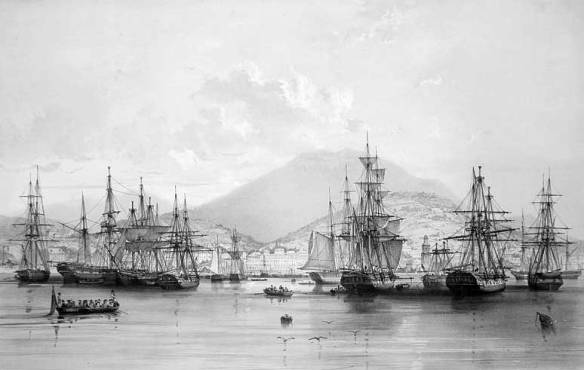
I’m finalising a book about one of my ancestors. She was transported from Ireland to VDL in 1849. Can you please tell me if this image of trading ships in Sullivans Bay is creative commons or not? I have only found it on your wonderful history blog.
Dear Madam,
I was wondering if you would be the one and same person who administers this other beautiful blog ( https://vkpeek.wordpress.com/ ), as I was hoping to be in contact with the owner of the images there.
Kind regards,
Bradley